Start a game
Pick a board size and slide any tile next to the empty slot. Start with 3×3 to learn the moves, then try the classic 4×4 15 puzzle.
Puzzle · Logic
Slide alchemy rune tiles back into order on a 3×3, 4×4 or 5×5 board. Every shuffle is solvable, and the method below works on any of them.
8 puzzle 3×3 · 15 puzzle 4×4 · 24 puzzle 5×5Free · No account needed
Pick a board size and slide any tile next to the empty slot. Start with 3×3 to learn the moves, then try the classic 4×4 15 puzzle.
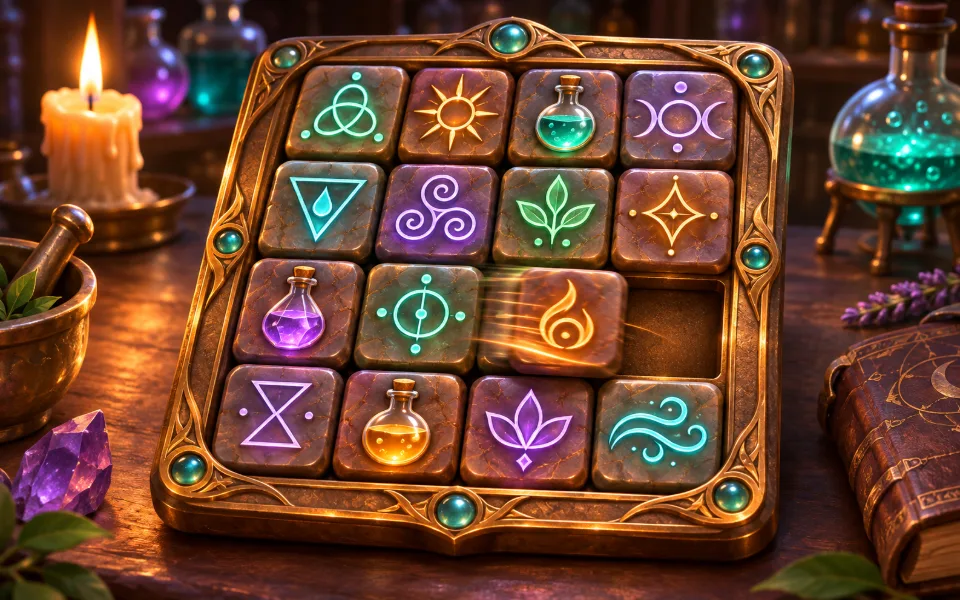
A free sliding puzzle online with alchemy rune tiles. Slide the tiles into order on 3×3, 4×4 or 5×5 boards; every shuffle is solvable, with moves, time and best scores.
The move counter adds one for every tile that slides. The timer has no limit and stops when the board is solved. Fewest moves and fastest time are saved separately for 3×3, 4×4 and 5×5 in this browser when local storage is available.
Stuck on a 3×3 or 4×4 board? The game opens your current position in the Sliding Puzzle Solver, which shows the fewest moves from there to the solved board.
You do not need to plan the whole board. Solve it in layers, and never disturb a finished row while you work below it.
Why can half of all arrangements never be solved? Count the inversions: pairs of tiles where a bigger number comes before a smaller one, reading row by row. A sideways slide never changes that count. On a board with an odd width, an up or down slide changes it by an even number, so its parity, odd or even, never changes; the solved board has zero, so only boards with an even count can be solved. On a 4×4 board, an up or down slide flips the parity while the empty slot changes row, so the inversion count plus the empty slot's row, counted from the bottom starting at 1, must be odd, as it is on the solved board (0 + 1). Swapping any two tiles breaks the rule, which is why a board with 14 and 15 swapped is unsolvable.
Solve it in layers. Finish the top row, then the next row, until two rows are left. Place the last two tiles of each row together. Then solve the last two rows one column at a time from the left, and cycle the final three tiles into place.
No. Exactly half of all tile arrangements can never be solved, because each slide preserves a parity count. Alchemy Slide checks that parity before you see a board, so every shuffle in the game can be solved.
They are the same game on different boards. The 8 puzzle is 3 by 3 with eight tiles, the 15 puzzle is 4 by 4 with fifteen tiles, and the 24 puzzle is 5 by 5 with twenty-four tiles. Bigger boards take more moves.
Every tile that moves counts as one move. Tapping a tile two places from the empty slot slides two tiles and adds two moves. Your fewest moves and fastest time for each size are saved in this browser.
Yes, for 3 by 3 and 4 by 4 boards. The game links your current board to the free Sliding Puzzle Solver, which shows the fewest moves from where you are. For 5 by 5, solve the top row and left column first.