MEOWDOKU GUIDE
Meowdoku rules, and how to solve every board.
Meowdoku is a cat logic puzzle for iPhone and Android by Oakever Games. Here are its rules in plain words and seven solving techniques, each with a worked board, so you can clear hard levels without guessing and without spending hearts.
Updated
Chaoschemy is not affiliated with Oakever Games or Meowdoku. This is an independent strategy guide. The rules come from the official store listings and press coverage linked under Sources. The boards below are our own examples, not levels from the app.
What are the Meowdoku rules?
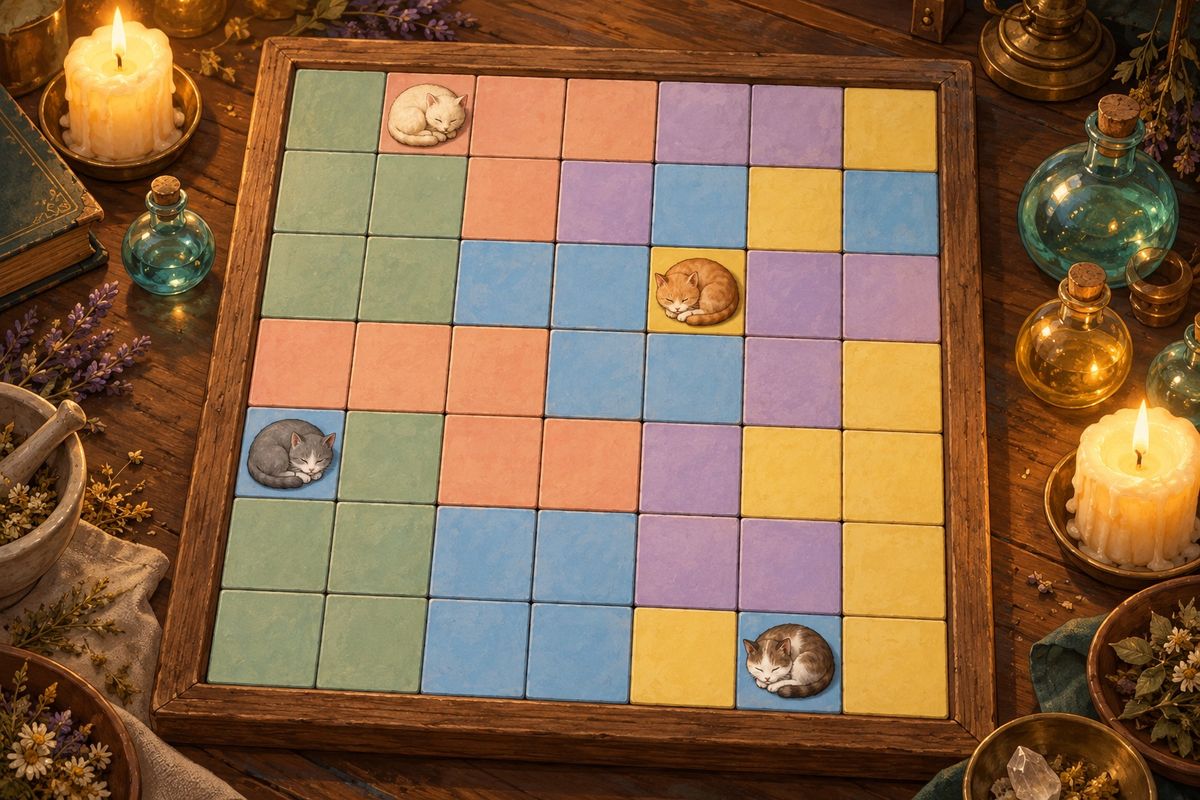
The board is a square grid divided into colored regions. You place cats until:
- every colored region holds exactly one cat,
- every row and every column holds exactly one cat, and
- no two cats touch, not side by side and not diagonally.
So a board with N rows has N columns, N regions and N cats. In the app you double-tap a tile to place a cat. A wrong cat costs one of your three hearts, and when the hearts run out you lose the level and start it again. Each board is meant to be solved by logic, so you never need to guess.
If you have played LinkedIn's Queens or a one-star Star Battle puzzle, these are the same rules with cats instead of crowns or stars, and every technique below works there too.
Meowdoku at a glance
| Developer | Oakever Games |
|---|---|
| Platforms | iPhone and iPad (App Store), Android (Google Play) |
| Price | Free, with ads and in-app purchases |
| Goal | One cat per row, column and colored region, with no cats touching |
| Placing a cat | Double-tap a tile |
| Mistakes | 3 hearts per level; a wrong cat costs a heart |
| Hints | Limited; you earn more by watching ads or through in-game rewards |
| Extras | A new daily puzzle every day, global leaderboards for fastest times, offline play |
Why you should never guess
Hearts make guessing expensive: three wrong cats and the level starts over. The habit that wins is to rule cells out before you rule cats in. Every time you prove a cell cannot hold a cat, cross it out in your head or with whatever marking your version of the app offers. When a row, column or region has only one cell left, that cell is a guaranteed cat, and placing it never costs a heart.
Each cat you place rules out a lot: the rest of its row, the rest of its column, the rest of its region, and the up-to-eight cells around it. The techniques below are the patterns that find the next safe cat when none is obvious.
Seven solving techniques, with worked boards
In each board, a green outline marks the cells the technique looks at, an × marks a cell it rules out, and a cat marks a cell it proves.
1. Start with one-cell regions
A region with one cell has nowhere else to put its cat. Scan for these first on every new board; they are free, and each one clears a whole row, a whole column and a ring of neighbors.
2. Look for the last cell standing
After every cat, check the regions, rows and columns it touched. Any of them that is down to one open cell is your next cat. On easy levels, this one technique repeated is the whole solve.
3. A region inside one row or column owns that line
Whenever all the open cells of a region lie in one row, that row's cat belongs to that region. Cross out every other cell in the row. The same works for a region whose open cells all sit in one column. This often applies only after a few cats have trimmed a region down, so look again after each placement.
4. A row or column inside one region
This is technique 3 turned around. If every open cell of a row (or column) belongs to one region, that region's cat is in that line, and the region's cells everywhere else are crossed out.
5. Small regions cast a shadow
Before you place a cat on a cell, ask what it would do to the smallest nearby region. If a cat there would cover or touch every open cell of some region, it would leave that region empty, so the cell is impossible. Two- and three-cell regions are where this pays off most.
6. Two regions in two rows
When two regions are both confined to the same two rows, those rows are spoken for. Every other region's cells in those rows are crossed out. Columns work the same way.
7. Count regions in a band of rows
Technique 6 scales up. Pick a band of k neighboring rows (or columns) and count the regions that fit entirely inside it. If k regions fit inside k rows, every other region is shut out of the band. It works in reverse too: if k rows have only k regions reaching into them, those regions' cells outside the band are crossed out. This is the move that cracks most big boards, and it is easy to miss because the regions involved can be far apart.
A routine for any level
- Place every one-cell region's cat, and cross out what each cat rules out.
- Check every region, row and column for a last open cell.
- Find regions confined to one row or column, and rows or columns confined to one region.
- Test the cells around the smallest regions for shadows.
- Count bands: two regions in two rows, three in three, from the top, the bottom and both sides.
- Go back to step 2 after every new cat.
Because each board has one logical solution, one of these steps always applies somewhere. If none seems to, you have usually missed a cross-out; recheck the neighbors of the cats already placed.
Stuck on a level? Hints, answers and level numbers
Use a hint as a nudge, not a solve. According to Android Central, Meowdoku gives you a limited number of hints, and you earn more by watching ads or through in-game rewards. Whatever the hint shows you, do not stop there: once you have a cat, cross out its row, column, region and neighbors, then run the routine above. One hint usually unlocks several cats you can prove yourself.
Why we do not post "level 20 answers". We do not have Meowdoku's level data, and we will not invent it. A screenshot of someone else's level 20 also may not match yours: the app is updated often, so the board behind a level number can differ between app versions or platforms, and the daily puzzle changes every day. The techniques on this page work on whatever board is in front of you, which no answer list can promise.
Copy the board when it gets big. On a ten-cat board, sketch the grid on paper with the region borders and work through the routine there. You can make every cross-out without risking a heart, then place only the cats you have proved.
Play a free cat puzzle in your browser
Want more boards like this between Meowdoku levels? Cat Nap is Chaoschemy's own free cat puzzle with the same kind of rules: one cat per row, column and colored region, and cats never touch. It runs in your browser on phone or desktop, with no download and no account. It is a separate game, not Meowdoku, and its boards are its own. Read how Cat Nap works, or start playing straight away.
Frequently asked questions
What are the rules of Meowdoku?
Place one cat in every row, every column and every colored region of the square grid. No two cats may touch, not even diagonally. In the app a wrong cat costs one of your three hearts.
Is Meowdoku the same as LinkedIn Queens?
The rules match: one piece per row, column and colored region, and no two pieces touching, even diagonally. Meowdoku uses cats, adds hearts for mistakes, and has its own levels and daily puzzles, so the same solving techniques work in both.
What happens if you place a cat in the wrong spot?
You lose a heart. The store listing gives you three chances per level, and Android Central notes that after three strikes you lose the level and start it over. That is why it pays to rule cells out before you place a cat.
Where can I find the answer to Meowdoku level 20?
We do not publish per-level answers: we do not have the app's level data, and a board shared under a level number may not match yours, because the app is updated often. Instead, place the one-cell regions first, look for the last open cell in each row, column and region, and count regions in bands of rows. One of those always finds the next cat.
Can I play Meowdoku online for free?
Meowdoku is a mobile app for iPhone and Android from Oakever Games. If you want a free browser game with the same kind of rules, try Cat Nap on Chaoschemy. It is our own game, not Meowdoku, and needs no download.
Who makes Meowdoku?
Meowdoku is made by Oakever Games. Chaoschemy is not affiliated with Oakever Games; this page is an independent strategy guide.
Sources
Rules and features checked on October 26, 2026. Wording and boards on this page are our own.
- Meowdoku on the App Store, Oakever Games: rules (one cat per colored section, no shared row or column, no touching even diagonally), double-tap to place, three hearts, daily puzzles and leaderboards.
- Meowdoku on Google Play, Oakever Games: the same rules and features for Android.
- "Meowdoku is sudoku but with cats…", Namerah Saud Fatmi, Android Central, September 20, 2026: ten-cat levels, three strikes, limited hints earned back through ads or rewards.